Monday, 27 January 2020

Sunday, 26 January 2020
Friday, 24 January 2020
Thursday, 23 January 2020
Wednesday, 22 January 2020
Tuesday, 21 January 2020
Sunday, 19 January 2020
Saturday, 18 January 2020
Friday, 17 January 2020
Myanmar’s Foreign Policy 2020
Myanmar’s Foreign Policy 2020
KB Teo
SYNOPSIS
Myanmar’s foreign policy is characterised by a strong nationalism.
A multiethnic state, Myanmar is developing close ties with its fellow ASEAN member states, China, and India.
COMMENTARY
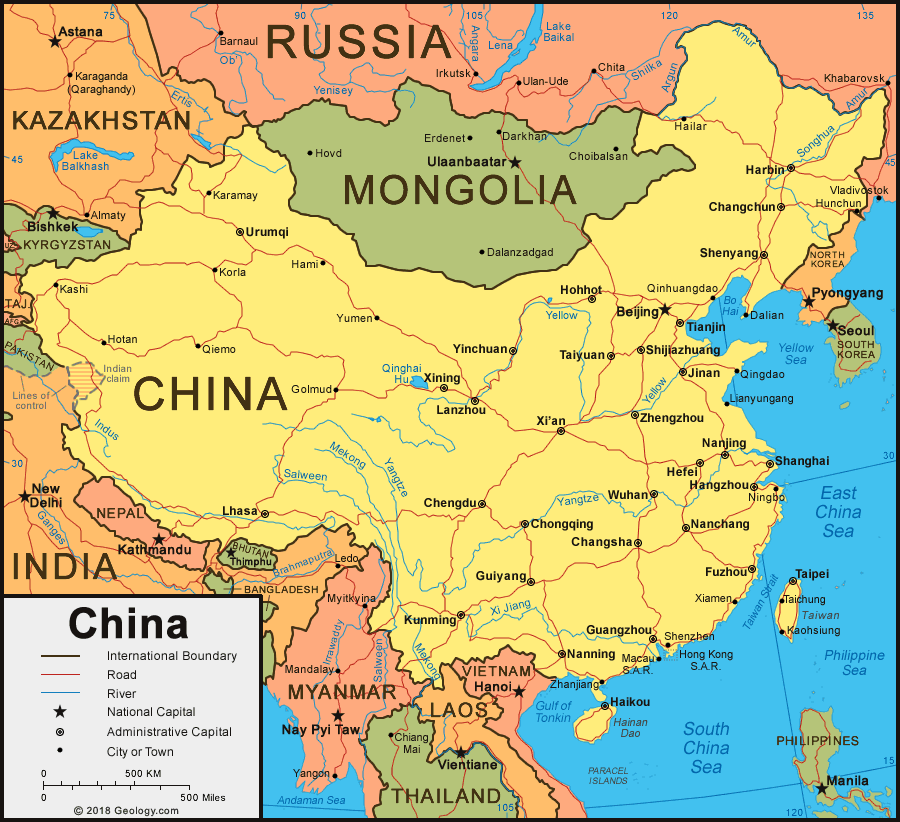
China and India dominate Myanmar’s foreign policy. Sandwiched between two active Asian giants, Nay Pyi Taw will have to balance its relations carefully as India and China vie with each other for greater influence. Myanmar must avoid being sucked into conflict zones in their common areas of influence.
The Rakhine crisis is an area where Beijing and New Delhi compete. The exodus to Bangladesh now number 750,000 Rohingyas. President Xi Jinping is increasing contact with Myanmar. Beijing has been actively facilitating peace talks and providing humanitarian aid. The Rakhine crisis presents an opportunity for China to test its diplomacy.
1
India would not easily let go of its involvement in Rakhine. During his recent visit here, Indian Foreign Secretary S Jaishankar pledged to provide US$25 million for the next five years to Myanmar to develop the troubled province. India knows it has an edge over China in raising the education standard, healthcare and human resource training as well as in empowering women and nurturing children in the region.
As a member of ASEAN, Myanmar has not engaged ASEAN and its members as much as it could. Since its successful chairing of the group in 2014, Nay Pyi Taw has focused on overall integration, especially in economic and social matters, within the ASEAN Community. Without Nay Pyi Taw’s proper signal and direction, ASEAN will not be able to provide any tangible assistance to alleviate the crisis in Rakhine. Past ASEAN engagements in East Timor and Aceh could provide valuable lessons for Nay Pyi Taw to emulate. Indonesia asked its ASEAN friends to help out with peace-building and rehabilitation in both cases.
2
There are two effective ways ASEAN can help. First, it can use bilateral initiatives. After the Rakhine crisis emerge with the 2012 exodus, Indonesia, Singapore, Malaysia and Thailand lent a helping hand, mainly on long-term security assistance and in tackling root causes. Since the August 2018 attacks, Indonesia, Singapore and Thailand have been friendlier and more responsive in helping Myanmar. They have dispatched humanitarian aid but have kept a low profile. Malaysia has been the most problematic because of its stand on the Rohingyas and its condemnation of Nay Pyi Taw. Responding to domestic pressure, the Najib government took a harsh position against Myanmar and severely criticised Nay Pyi Taw and its leader for failing to stem the tide of refugees flowing across the border.
The second approach is for Myanmar to ask for help from ASEAN. State Counsellor and Foreign Minister Daw Aung San Suu Kyi can do that with the new ASEAN chair, Singapore, which has given priority to maintaining peace and stability in the region.
Aung San Suu Kyi wants to keep ASEAN at a distance for fear of growing foreign interference. She is also mindful not to upset the role of Myanmar’s powerful military. With ASEAN support, Myanmar can fend off further pressure from the global community.
3
China had poor relations with Myanmar until the late 1980s. Between 1967 and 1970, Burma broke relations with Beijing because of the latter's support for the Communist Party of Burma (CPB). Deng Xiaoping visited Yangon in 1978 and withdrew support for the long running insurgency of the Communist Party of Burma. In the early 1950s, Burma enjoyed a hot-and-cold relationship with China.
Burma's U Nu lobbied for China's entry as a permanent member of the UN Security Council, but denounced the invasion of Tibet. China and Burma have had many border disputes, dating before the British annexation of Burma. The last border dispute culminated in 1956, when the People's Liberation Army invaded northern Burma, but were repulsed. A border agreement was reached in 1960 In the late 1960s.
Many Sino-Burmese were influenced by the Cultural Revolution in China. Shops were ransacked. Beijing heavily criticised the Burmese government. The anti-Chinese riots continued till the early 1970s. After 1986, China withdrew support for the CPB and began supplying the military junta with the majority of its arms in exchange for increased access to Burmese markets and a naval base on Coco Islands in the Andaman Sea.
4
China is supposed to have an intelligence gathering station on the Great Coco Island to monitor Indian naval activity. The influx of Chinese arms turned the tide in Myanmar against the ethnic insurgencies, many of which had relied indirectly on Chinese complicity. As a result, the military junta of Myanmar is highly reliant on Beijing for their power. In July 2019, UN ambassadors from 50 countries, including Myanmar, signed a joint letter to the UNHRC defending China's treatment of Uyghurs in the Xinjiang region. Beijing is highly appreciative of Myanmar’s support.
5
-----------------------------------------------------------------------------
KB Teo is a former diplomat with the Singapore Ministry of Foreign Affairs. He attended the UN General Assembly as part of the MFA delegation.
Myanmar’s Political Economy 2020:Economic Reforms and Rohingyas
Myanmar’s Political Economy 2020:
Economic Reforms and Rohingyas
KB Teo
SYNOPSIS
Myanmar is focused on capitalist economic opening to achieve higher growth. There are strong Western criticisms against its Rohingya policy. Yangon prioritises relations with ASEAN and China.
COMMENTARY
Myanmar State Counsellor Aung San Suu Kyi’s National League for Democracy (NLD) prioritises economic liberalisation. The military (Tatmadaw) retains very strong influence. Ongoing conflict in Rakhine state is hindering efforts to repatriate Rohingya refugees. Yangon is seeking to strengthen relations with ASEAN, China, and Japan. Robust infrastructure investment ensures that Myanmar’s growth remains one of the fastest in ASEAN.
The Regional Comprehensive Economic Partnership (RCEP) moved closer to realisation following the ASEAN summit in November 2019. It will become the world's biggest FTA.
1
Myanmar has taken the first step in planning for the 2020 implementation of 5G telecommunications services. Mytel, a joint venture between the Tatmadaw and Vietnam's defence ministry, tested 5G technology provided by Chinese telecoms equipment manufacturer, Huawei, in August 2019. The state-owned Myanmar Posts and Telecommunications (MPT) has indicated its readiness to implement the technology in the near future.
With a potential customer base of more than 650m people, the ASEAN region holds great promise. Yangon views ASEAN as an expansion opportunity for global digital platform providers. Businesses can leverage established digital platforms to reach untapped ASEAN markets and expand their customer base. The region is an attractive destination for global companies, including digital platform providers that offer localised versions of their services. At the same time, ASEAN is increasingly producing its own set of innovative internet companies that aspire to enter new markets.
2
Almost everyone in Myanmar has a mobile phone, but fast and reliable internet connections remain out of reach beyond the major cities. It expects to need another two to three years for facility upgrades before 5G can be used in major cities.
The development of 5G services in Myanmar will lead to economic gains over the next five years. The government is committed to pushing through a modernisation agenda. When it comes to attracting foreign investment, such signalling may be as important as any actual policy changes that the government introduces.
Rohingyas
Buddhist-Myanmar want the Muslim Rohingyas out at almost any costs. So far, an estimated 30,000 Rohingyas have been killed in extreme violence in the northern Rakhine state. The UN has accused Myanmar of genocide against the Rohingyas. In December 2019, State Counsellor Aung San Suu Kyi stoutly defended Myanmar against the genocide charge at the Hague.
3
ASEAN-Myanmar Relations
Myanmar was one of those new members, joining ASEAN together with Laos on 23 July 1997 at ASEAN’s 30th anniversary. Myanmar’s milestones of ASEAN membership each decade are thus linked with those of ASEAN. The 20-year mark of Myanmar’s ASEAN membership also coincides with the beginning of a new chapter in the country’s contemporary history.
Myanmar’s 10th ASEAN anniversary in 2007 had little cause for celebration. That year, the interactions between ASEAN the Association and Myanmar as a member of that Association had reached their lowest point over the military regime’s crackdown on the Saffron Revolution. ASEAN issued its strongest statement on Myanmar. Yangon rejected ASEAN’s interest to have the United Nations Special Advisor brief the 13th ASEAN Summit on the situation in the country.
Myanmar celebrates August 8 as ASEAN Day. It is a sensitive matter. August 8 marks another anniversary in Myanmar: the nation-wide democracy movement that was put down by in a bloody coup in 1988. This year, however, is different. The August 8, 1988 memories are no longer behind closed doors.
4
Myanmar is still a relative newcomer in terms of leading regional actions. Decades of military rule had put Myanmar in a passive, reactive position in ASEAN affairs. Even when Myanmar held the rotational ASEAN Chair in 2014, the expectations were more of maintaining the existing regional momentum than initiating something new. Myanmar’s foreign policy orientation can help ASEAN’s balancing act. Daw Aung San Suu Kyi, in her debut attendance at the 49th ASEAN Ministerial Meeting in July 2016, had shared Myanmar’s hard experience in dealing with “bullies”. When taking office in April 2016 as State Counsellor, Daw Suu Kyi had affirmed continuation of the country’s neutralist and independent foreign policy.
Myanmar worked with ASEAN in dealing with the humanitarian situation after the 2008 Cyclone Nargis, and to discuss the more recent situation in Rakhine. ASEAN views its regional integration project as a “work-in-progress”. Myanmar’s ASEAN membership provides a platform for linking national interests with regional priorities.
5
China-Myanmar Relations
Beijing has a very strong influence in Myanmar. Myanmar established diplomatic relations with China in 1949—one of the first non-socialist countries to do so—and has relied heavily on Chinese investment and support since 1988, when a military junta seized government control. Myanmar was consequently placed under severe Western sanctions.
Beijing views Myanmar as a highly strategic country. They share a 2,200km border that has been plagued by ethnic conflict for decades. Myanmar is also vital to President Xi’s “One Belt One Road” project. Access to the Indian Ocean through Myanmar would decrease Beijing’s heavy reliance on the narrow and vulnerable Straits of Malacca for imports. More specifically, the land holds the key to meeting China’s energy needs; massive Chinese infrastructure investments include the Sino-Myanmar oil pipeline, which began operating in 2013, and the USD 3.6 billion controversial Myitsone dam.
6
In early 2019, Myanmar reported bilateral trade with China from just the first eight months of fiscal year 2017-18 as worth USD 7.42 billion. This number projects a strong uniformity with last fiscal year’s trade (USD 10.8 billion) and demonstrates renewed ties between the two nations after an abrupt cooling off period since 2011, when Myanmar began the democratic reform process.
In 2016, Singapore was Myanmar’s largest foreign investor. For more than two decades, it was China. There is a growing rapprochement between Myanmar and the US. Myanmar was isolated from much of the global economy under military junta rule, making its government especially dependent on China. In response, China placed a strong emphasis on its powerful relationship with the Yangon government.
7
-----------------------------------------------------------------------------
KB Teo is a former diplomat with the Singapore Ministry of Foreign Affairs. He attended the UN General Assembly as part of the MFA delegation.
Wednesday, 15 January 2020
Tuesday, 14 January 2020


Monday, 13 January 2020
Sunday, 12 January 2020
Friday, 10 January 2020

Malaysia’s Succession Struggle 2019: Economic Slowdown and Instability?
Malaysia’s Succession Struggle 2019:
Economic Slowdown and Instability?
KB Teo
SYNOPSIS
Malaysian politics is engulfed in controversy and uncertainty. The vicious succession to PM Mahathir within the ruling Pakatan Harapan (PH) coalition threatens to worsen. The economy is slowing rapidly and foreign investments have fallen sharply. Unless the succession issue is quickly resolved, instability threatens.
COMMENTARY
Malaysian politics is currently in turmoil. In November 2019, factional infighting within the Parti Keadilan Rakyat (PKR) broke out. The PKR is the second largest component of the ruling multiethnic (PH (Coalition of Hope), led by PM Mahathir Mohamad, 94. He was Malaysia’s leader from 1981 to 2002, the longest on record. It also includes the Chinese-based Democratic Action Party led by Lim Kit Siang and his son, Finance Minister Lim Guan Eng. The latter has corruption charges pending against him in relation to the purchase of a bungalow in Penang. The prosecution, controlled by the Attorney General, dropped the charges against Lim.
1
The PH coalition surprisingly won the May 2018 Malaysian General Elections (GE14), ousting the corrupt Barisan Nasional (BN) administration of Premier Najib Razak. Najib is implicated in the 1MDB scandal, the largest of its kind in the world. It has debts of USD 11.73 billion. About USD 700 million was reportedly transferred to Najib’s private bank accounts. The US Justice Department claimed that USD 4.5 billion was stolen from the 1MDB. The BN had ruled Malaysia continuously for 61 years.
In November 2019, Anwar Ibrahim, 72 (leader, PKR), was challenged by his deputy, Azmin Ali, 55. Azmin is very ambitious. He has the political support of Mahathir. There was apparently a “promise” made by Mahathir to make way for Anwar to become Prime Minister midway through the HP’s term of office. Reports indicate that Mahathir has since denied making such a promise. Mahathir has deliberately been coy about a power transfer dateline. Anwar has, however, publicly expressed strong confidence that he will become Malaysia’s next leader by June 2020.
2
There are, however, clear benefits for Malaysia if Mahathir sets a timeline for the succession. One, it will stop the political uncertainties in Malaysia, which risk descending into an all-out war. Two, it will enable Mahathir to focus on fixing the slowing economy.
In 2019, the economy is expected to grow by only 4.7%. Manufacturing is slowing rather quickly. The Purchasing Managers’ Index has stayed below 50, signalling contraction. Since early 2019, the RAM Business Confidence Index has been sluggish. The high cost of living contributed to PH’s defeat in the Pulau Piai by-election.
There are media reports suggesting that Mahathir may have political ambitions for his 54-year old son, Mukhriz. Najib has also accused Mahathir of seeking to make Muhkriz the next prime minister of Malaysia. The latter’s brother, Mokhanzani, according to Forbes magazine, is reportedly one of Malaysia’s top ten billionaires. He is among the top ten richest tycoons in Malaysia. Mukhriz is the Menteri Besar (Chief Minister) of the northern Kedah state. But Mahathir claimed that his sons are rich because of their own efforts.
3
The PKR factional infighting already has negative results for the PH coalition. In June 2019, it lost decisively in the Tanjung Piai by-election back to UMNO. UMNO deputy president Mohamad Hasan voiced concern that PKR leaders continue to quarrel over the prime minister’s post.
Mohamad Hasan said it was unfortunate that there had been no discussions on urgent economic issues including the ringgit’s drop in value and rising debt. Billions of ringgit in foreign investment has left Malaysia’s Stock Exchange. Its performance in 2019 is among the worst in the world. The amount of foreign investment which left Malaysia in 2019 was reportedly more than RM10 billion. The Malaysian economy is evidently slowing.
Anti-corruption promises lay at the heart of Pakatan Harapan's 2018 election win. A priority is its pledge to get to the bottom of the 1MDB scandal. As much as USD 4.5 billion went missing. Jho Low, a financier accused of orchestrating the theft, remains at large. In October 2018 the U.S. Department of Justice announced that Jho had agreed to forfeit nearly USD 1 billion in assets allegedly bought with the fund's money. Instead, Malaysia's attention has shifted to former Prime Minister Najib Rasak, who has pleaded not guilty to 42 criminal charges charges ranging from money laundering to abuse of power.
4
The new Mahathir administration faces many political challenges. There are three key issues that the administration must address before the next General Election in 2023. These are the Malay Agenda/Bumiputra Policy; political Islam; and the timeline for transition of power from Mahathir to Anwar Ibrahim. Mahathir needs to clearly signal that Anwar will be his successor. Only then will the economic slowdown slacken and the political uncertainty subside.
5
-------------------------------------------------------------------------
KB Teo is a former diplomat with the Singapore Ministry of Foreign Affairs. He attended the UN General Assembly as part of the MFA delegation.
Wednesday, 8 January 2020

Monday, 6 January 2020
Thursday, 2 January 2020
Wednesday, 1 January 2020
Subscribe to:
Posts (Atom)


